
Service · St. Petersburg, FL
Tree Cabling & Bracing in St. Petersburg
Support systems for co-dominant trunks and heavy limbs on trees that are structurally sound enough to save, rather than remove. Especially common on mature live oaks.
Tree Cabling & Bracing Services in St. Petersburg, FL
Not every structurally weak tree needs to come down. A mature live oak with a co-dominant trunk — two roughly equal-sized stems splitting from low on the trunk — can carry that weakness for decades without failing, or it can fail catastrophically in one strong storm, and the difference often comes down to whether it has support. Cabling and bracing are the two systems that provide that support, and on a tree worth keeping — which in St. Petersburg's older neighborhoods often means a tree that took fifty or more years to reach its current size — they can be the difference between saving the canopy and starting over.
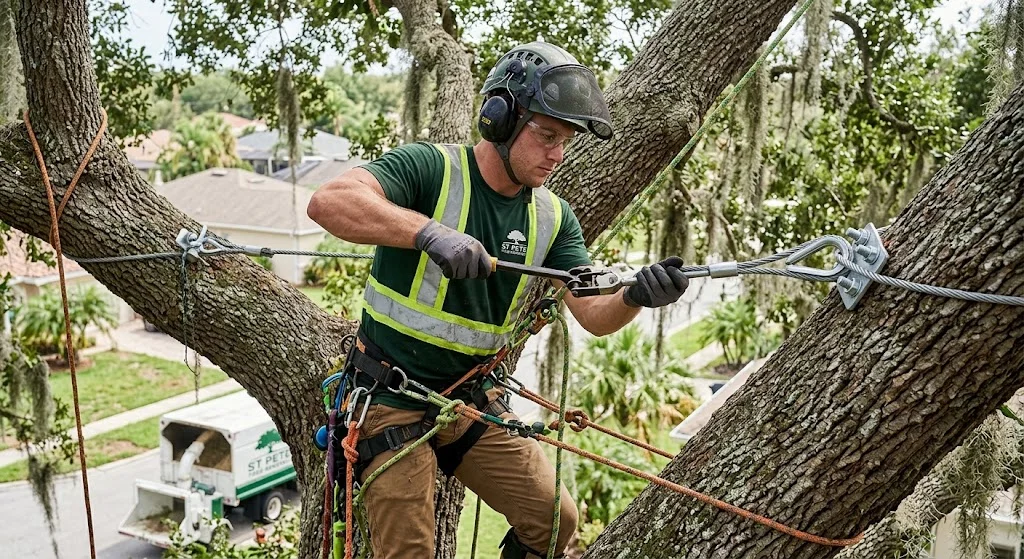
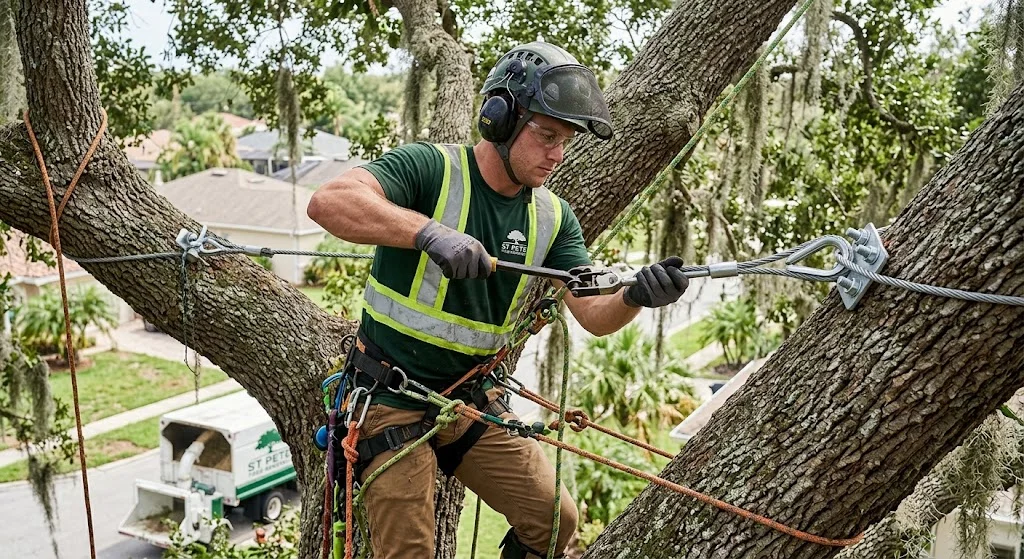
Cabling installs flexible steel cable high in the canopy to limit how far two stems or a heavy limb can move apart under wind load. Bracing installs threaded steel rods through a trunk or major limb union to provide rigid support at a weak point, typically where a crack or included bark has already developed. The two are often used together on the same tree — cabling to manage overall canopy movement, bracing at a specific structural failure point.
When cabling or bracing makes sense
- Co-dominant trunks — two main stems of similar size splitting low on the tree, a common structure on mature live oaks.
- Included bark unions — where bark grows inward between two limbs instead of forming a strong outer union, a hidden weak point.
- Heavy horizontal limbs — large limbs extending far from the trunk that have begun to sag or show stress cracks.
- Trees with historic or high value — specimen and grand trees where removal is either heavily regulated or simply not something the owner wants to consider.
- A limb or trunk with a minor existing crack — caught early enough that support can arrest the problem rather than let it worsen.
- Trees near structures where the consequence of failure is high — cabling reduces risk on a tree you'd rather not remove but also can't afford to have fail.
What cabling and bracing costs
A standard cabling installation, supporting one or two weak points high in the canopy, runs $300 to $900. Bracing, which involves drilling and installing threaded steel rods, runs $400 to $1,200 depending on the number of rods and their length. Trees needing both systems together typically run $600 to $1,800. Cost scales with the tree's size, the number of support points needed, and access — cabling forty feet up in a large oak canopy takes longer and more equipment than a similar job on a smaller tree.
| Job | Typical range | What moves the price |
|---|---|---|
| Single cable installation | $300 – $600 | Height and canopy access |
| Multi-point cabling system | $600 – $900 | Number of support points |
| Single bracing rod | $400 – $700 | Rod length and drilling access |
| Multi-rod bracing system | $800 – $1,200 | Number of rods and complexity |
| Combined cabling + bracing | $600 – $1,800 | Full scope assessment on site |
| Annual inspection (existing systems) | $75 – $150 | Verifying cable tension and hardware condition |
Cabling live oaks specifically
Live oaks are the single most common candidate for cabling in St. Petersburg, precisely because their growth habit — wide-spreading, often with multiple large co-dominant limbs from a relatively short trunk — creates exactly the structural situation cabling is designed for. A mature oak in Old Northeast or Snell Isle with a fifty-foot canopy spread and a questionable trunk union is a textbook cabling candidate rather than a removal candidate, especially given how long a replacement tree would take to provide comparable shade and canopy.
What cabling will not fix
Cabling and bracing manage structural risk on a tree that is otherwise alive and reasonably sound. They do nothing for internal decay, root plate failure, or a tree that is already dead or dying. If our assessment finds that the underlying problem is decay rather than simple structural geometry, we will tell you that cabling would provide false confidence rather than real support, and recommend removal instead.
Inspection and maintenance
Existing cable and brace systems, whether installed by us or a previous company, should be inspected periodically to confirm the hardware is still properly tensioned and hasn't begun to girdle the growing wood around it. We offer inspection-only visits for $75 to $150 and will tell you honestly if a system we didn't install needs adjustment or replacement.
Where we install cabling and bracing
Across our service area, with the heaviest demand in the mature live oak neighborhoods of Old Northeast, Historic Kenwood, Crescent Lake and Snell Isle.
Questions
Tree Cabling & Bracing FAQs
Cabling installs flexible steel cable high in a tree's canopy, connecting two major stems or limbs to limit how far they can move apart under wind load. It doesn't prevent the tree from swaying naturally, but it stops a structurally weak union from separating catastrophically in a strong gust.
Cabling uses flexible steel cable installed high in the canopy to limit movement between stems. Bracing uses rigid threaded steel rods drilled directly through a trunk or limb union to provide fixed structural support at a specific weak point, typically where a crack has already started to develop. Many trees benefit from both, used together.
A standard single-point cabling installation runs $300 to $600, and multi-point systems supporting several weak areas run $600 to $900. Bracing runs $400 to $1,200 depending on the number of rods. Combined systems run $600 to $1,800. Height, canopy access and the number of support points needed are what move the price.
Cable and rod hardware itself typically lasts many years, but the system should be inspected periodically — we recommend every one to two years — to confirm tension and hardware condition as the tree continues to grow around the installation. We offer standalone inspection visits for existing systems.
It significantly reduces the risk from the specific structural weakness it addresses, but it does not make a tree storm-proof. Extreme wind events, direct lightning strikes, or a separate undetected problem like root or trunk decay can still cause failure. Cabling is risk reduction, not a guarantee.
Cabling is appropriate when the tree is otherwise alive and structurally sound apart from a specific weak point — most commonly a co-dominant trunk or included bark union — and removal is appropriate when there's significant internal decay, root failure, or the tree is already dead or dying. We assess this on site and will recommend removal rather than cabling if that's genuinely the safer and more honest answer.
Properly installed cabling causes minimal harm — modern cabling hardware doesn't require drilling in most installations, since cables are typically attached using through-bolts or non-invasive collar systems designed to avoid unnecessary wounding. Bracing does require drilling for the rods, which creates a small wound the tree compartmentalizes over time, similar to any other pruning cut.
For a mature specimen oak, almost always worth it. A replacement tree of comparable size and canopy spread would take fifty or more years to grow, while cabling a structurally compromised but otherwise healthy oak for a few hundred to under two thousand dollars can extend its safe life by decades. The math strongly favors saving an established tree wherever that's a genuine option.
Most installations are completed in a few hours to a full day, depending on the tree's size, the number of support points, and access. Climbing is usually required to install cables correctly high in the canopy, which is factored into the time and the quote.
Yes, two years on workmanship. If hardware fails under normal load within that window, we return and correct it at no charge. Damage from an extreme storm event or direct lightning strike is not a workmanship issue, but we'll assess and repair it at our standard service rate.
Yes. We offer standalone inspection visits for $75 to $150 to check tension, hardware condition, and whether the tree has grown in a way that affects the system's function. We'll tell you honestly whether it looks properly installed and whether any adjustment or replacement is warranted.
Yes — cabling addresses a structural weak point, but it doesn't replace normal maintenance pruning. Continued deadwooding and canopy thinning, covered under tree trimming and pruning, remain important for a cabled tree's overall health and to reduce the wind load the cable system has to manage.
Related
Other tree work we do
Get a price for your tree cabling and bracing
Free on-site estimate with a flat written price before we start. Call or send photos and we will tell you what it costs.
Mon–Sat 7:00am–7:00pm (24/7 emergency line for storm work) · Licensed & insured · Serving St. Petersburg, Gulfport, Largo & the beaches