
Licensed & insured Free on-site estimates Same-week scheduling Pinellas County & beaches
Call 727-624-0396

Tree Health

Signs a Tree Is Dying or Hazardous (and Needs to Come Down)

A tree can look rough and still be perfectly safe, or look fine and be genuinely dangerous. These eight signs are what we actually check, in order of how seriously we take them.

Homeowners often assume a tree is a problem because it looks unattractive — sparse, oddly shaped, dropping more leaves than usual for the season. Cosmetic concerns and genuine hazards are two different things, and confusing them leads people either to remove trees that were fine, or to leave genuinely dangerous ones standing because they still had green leaves.

The eight signs we take most seriously

1. A sudden or pronounced lean

Some trees grow with a natural lean their whole life and are perfectly stable. A lean that developed suddenly, especially after wind or heavy rain, is a different situation entirely — it often indicates root failure on one side, and can precede a full failure with very little further warning.

2. Fungus or mushrooms at the base or on the trunk

Fungal conks, especially shelf-like growths at the trunk base, frequently indicate internal decay that is not visible from the outside. Different fungi target different parts of the tree's structure, but the general rule holds: visible fungus on a mature tree warrants a professional look at what is happening underneath the bark.

3. Large dead limbs in the upper canopy
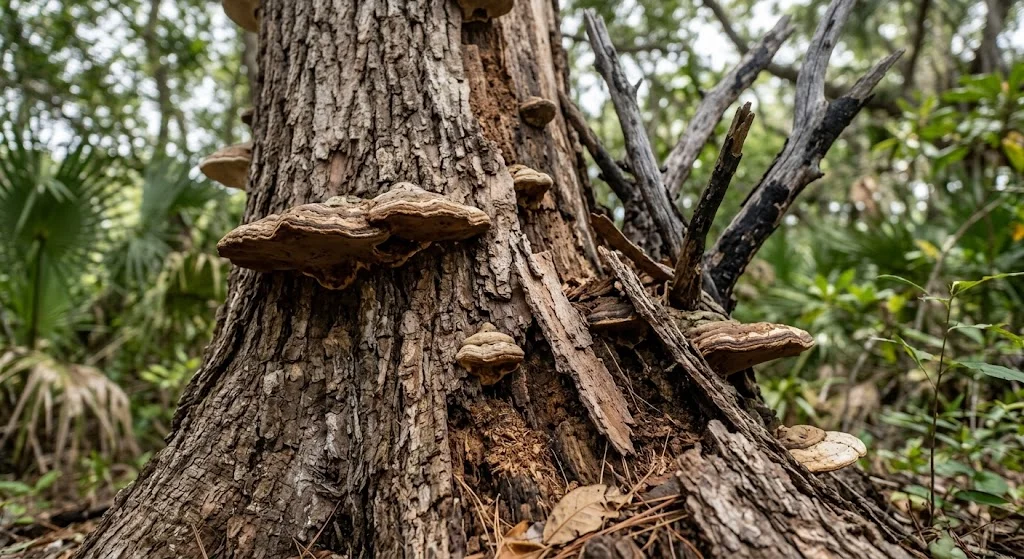
Dead limbs and canopy dieback on a declining tree in St. Petersburg

Isolated dead branches are normal on almost any mature tree and often just need routine deadwooding. Large dead limbs, especially several of them concentrated in the upper canopy, suggest a more significant decline and deserve a closer look at the tree overall.

4. Cracks running down the trunk

A vertical crack, especially one that runs a significant portion of the trunk's length, is a serious structural concern. It indicates the wood fibers have already begun to separate, and the crack typically worsens over time rather than healing.

5. A hollow sound when tapped

Tapping the trunk with a mallet or the back of an axe and listening for a hollow versus solid sound is a rough but genuinely useful field test for internal decay. It is not definitive on its own, but combined with other signs it is one more data point toward a removal recommendation.

6. Root damage or a lifted root plate

Construction work, soil compaction from heavy equipment, or a visibly lifted root plate on one side of the trunk all indicate compromised root support. A tree with significant root damage can look completely normal above ground while being structurally unstable below it.

7. Included bark at a major limb union
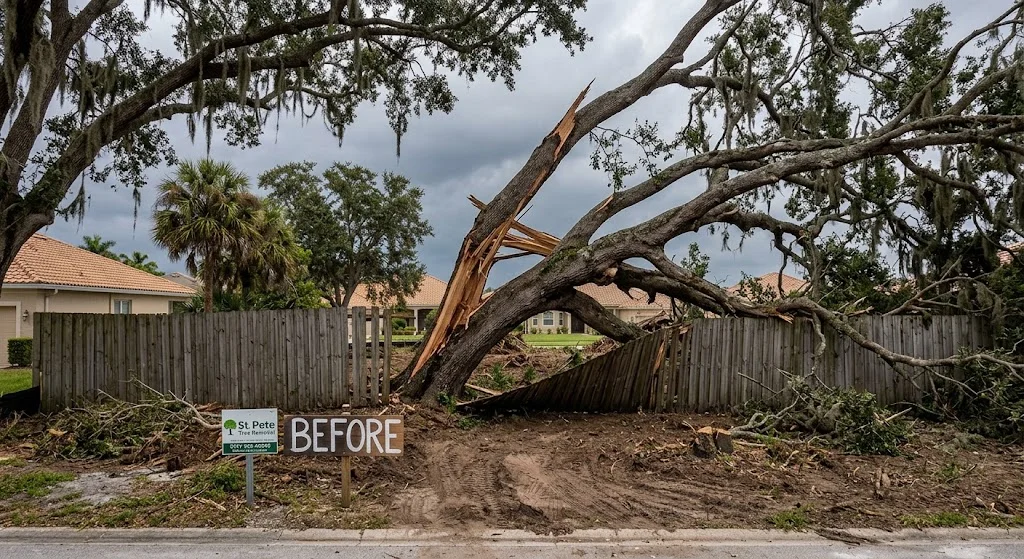
Arborist assessing a leaning hazardous tree near a home in St. Petersburg

This is where two limbs or trunks grow together with bark trapped between them rather than forming a strong outer union — a hidden weak point that is not always obvious without a trained eye. It is exactly the kind of structural issue cabling is designed to address on a tree that is otherwise worth keeping.

8. Repeated limb failure in calm weather

A tree that drops large limbs without an obvious weather trigger is telling you something is wrong internally. One dropped limb after a storm is normal; repeated failures with no clear external cause are not.

Two or more signs together is the real thresholdAny single sign on this list might mean nothing serious on its own. Two or more together — especially combined with proximity to a structure, driveway, or area where people spend time — is when we start recommending action rather than continued monitoring.

What to do if you spot these signs

Call for an assessment rather than trying to diagnose it yourself from the ground. We check all eight of these during any estimate involving a tree showing signs of decline, and we will tell you plainly whether the answer is removal, trimming, or nothing at all. A tree with real years left in it deserves better than a nervous removal based on incomplete information.

When it genuinely cannot wait

A sudden lean toward a structure, a large crack that has visibly worsened, or a root plate that has lifted are all situations we treat as urgent rather than something to schedule routinely. If you are seeing any of those specifically, call our emergency line rather than waiting for a standard estimate window.

Need this looked at? Free on-site estimate anywhere in our service area, with a flat written price before we start. Call 727-624-0396 or request a quote.

Questions

Related questions

No single sign is fully reliable on its own — we look for combinations. A sudden lean combined with visible root lifting, or fungal growth combined with a hollow sound when tapped, moves a tree from "worth monitoring" to "needs professional assessment soon" much faster than any one sign alone.

Not always, but it always warrants a closer look. Fungal growth at the base frequently indicates internal decay that is not visible from the outside, though the extent and location of that decay determines how serious the risk actually is. It is not something to ignore, but it is not automatically an emergency either.

Yes, this is one of the more common surprises in tree assessment. Root damage from nearby construction, soil compaction, or a lifted root plate can leave a tree with a full, green canopy while being structurally unstable at the base — which is part of why a professional assessment matters more than a visual check from a distance.

Not necessarily, and this is one of the most common false alarms. Seasonal leaf drop, drought stress, or a temporary response to root disturbance can all cause unusual leaf loss without indicating the tree is actually dying. Genuine decline usually shows up alongside other signs like dead limbs or trunk issues, not leaf drop alone.

It typically means the wood fibers have already begun to separate under stress, and the crack generally worsens over time rather than healing itself. A significant vertical crack, especially one running a large portion of the trunk's length, is a serious structural concern that warrants prompt assessment.

A single large limb failure during or after a significant storm is fairly normal and does not necessarily indicate a bigger problem. Repeated limb failures with no obvious weather trigger, however, suggest an internal issue and deserve a closer look.

Sometimes, depending on the cause and severity of the lean. A tree that has always grown with a mild, stable lean is often fine as-is. A lean that developed suddenly, especially with visible root lifting on one side, is a different and more serious situation that usually points toward removal rather than a saving intervention.

It is a structural condition where two limbs or trunks grow together with bark trapped between them instead of forming a strong outer union, creating a hidden weak point. It is not always visible without a trained eye, and it is exactly the kind of issue cabling and bracing are designed to address on a tree worth keeping.

If you are seeing one isolated, minor sign — a single dead branch, mild seasonal leaf drop — monitoring is often reasonable. If you are seeing two or more of the eight signs together, especially near a structure, an assessment is worth scheduling rather than continuing to watch and wait.

It is a useful field indicator but not fully definitive on its own. A hollow sound suggests possible internal decay and warrants further investigation, but the test alone does not tell you the extent of the decay or exactly how much structural integrity remains.

Yes, and this is a commonly overlooked cause. Soil compaction from heavy equipment and root damage from excavation near a tree can compromise its root support in ways that may not become visibly apparent for months or even years afterward.

Do not wait for a scheduled routine estimate if the signs suggest genuine urgency — a sudden lean toward a structure, a large worsening crack, or a visibly lifted root plate. Call our emergency line for anything that looks like it could fail soon rather than treating it as a standard appointment.

Get your tree taken down right

Free on-site estimate, flat written price, and a crew that does nothing but trees. Tell us what needs to come down and we'll tell you what it costs.

Mon–Sat 7:00am–7:00pm (24/7 emergency line for storm work) · Licensed & insured · Serving St. Petersburg, Gulfport, Largo & the beaches

Tap to call Free quote