
The reason nobody publishes tree removal prices is that it makes quotes comparable, and comparable quotes compress margins. We publish them anyway, because the alternative is a market where homeowners have no way to tell a fair number from a padded one.
The short answer
| Item | Detail |
|---|---|
| Small tree, under 30 ft | $300 – $800 |
| Medium tree, 30–60 ft | $800 – $1,600 |
| Large / mature tree, 60 ft+ | $1,600 – $2,500+ |
| Crane-assisted removal | +$500 – $1,500 |
| Emergency / priority callout | +25% – 50% |
| Stump grinding add-on | $75 – $400 per stump |
Those are St. Petersburg-area numbers for a competent removal with full cleanup included. If you are quoted meaningfully below the bottom of those ranges, something is usually being left out, and the rest of this article is about identifying what.
The six things that actually move the price
1. Size, not just height
Height matters, but canopy spread and trunk diameter matter just as much. A sixty-foot oak with a fifty-foot canopy spread is a considerably bigger job than a sixty-foot pine with a narrow crown, even though both hit the same height bracket. Estimators account for total volume and weight, not just the tallest point.
2. Species and wood density
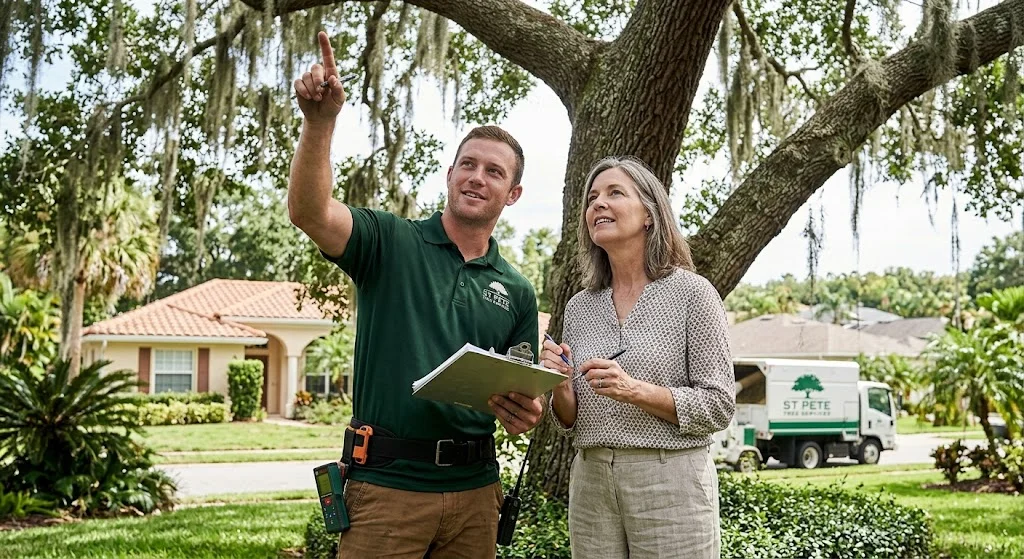
Live oak wood is dense and the branch structure is often wide and heavy, which means more rigging and more time per removal than a similarly sized pine or palm. Palms, by contrast, are usually faster and cheaper to remove than a hardwood of comparable height, since the trunk is a single column rather than a spreading structure that has to be taken down in sections.
3. Lean, access and drop zone
A tree with room to be dropped whole, away from structures, is the cheapest scenario. A tree leaning toward a house, wedged between two other trees, or on a lot with no equipment access requires piece-by-piece rigging or a crane, both of which add meaningfully to labor time and equipment cost.
4. Whether a crane is needed
Crane-assisted removal typically adds $500 to $1,500 to a job. It becomes necessary when climbing access is unsafe or impossible — heavily obstructed lots, trees surrounded by structures on multiple sides, or waterfront properties where a climber cannot safely rig a controlled drop. See our Snell Isle area page for an example of a neighborhood where this comes up often.
5. Permit requirements
If the tree qualifies as a protected specimen or grand tree under City of St. Petersburg code, permit processing adds time to the schedule, though usually not a large amount to the removal cost itself beyond the paperwork and documentation involved. This applies more often in historic-canopy neighborhoods like Old Northeast than in newer subdivisions.
6. Stump grinding, included or separate
Removal pricing typically covers cutting the tree down to a flush stump, not grinding it out. Stump grinding is quoted separately at $75 to $400 depending on diameter. A quote that seems unusually cheap sometimes turns out to exclude stump grinding entirely, which then shows up as a surprise add-on later.
What a suspiciously cheap quote usually means
- No cleanup included. The tree comes down but the debris is left for you to deal with, which is not what most people picture when they hear a total price.
- Stump grinding excluded silently. Quoted as if it is included, then added on afterward.
- Permit status not checked. A cheap, fast removal on a protected tree can create real problems for the property owner after the fact, regardless of who did the cutting.
- Uninsured labor. The single biggest risk in this trade — if someone is hurt or property is damaged and the company carries no insurance, that liability can land on you as the property owner.
- No written price at all. A verbal number that changes once the crew arrives is the oldest trick in the business.
Is removal or trimming the better value?
Judge it by what is actually wrong with the tree. If the issue is isolated dead wood, a single weak limb, or a structurally correctable co-dominant trunk, trimming or cabling is both cheaper and preserves a tree that may have taken decades to reach its current size. Removal makes sense when the tree is dead, has significant structural failure, or the hazard genuinely outweighs the value of keeping it.
What we would tell you on your property
If your tree has a few good years left with the right trimming, we say so and quote that instead of a removal. If a crane genuinely is not needed but a previous quote assumed one, we'll tell you. If the tree is protected, we'll explain the permit process honestly rather than skip it to move faster. Full pricing detail lives on our tree removal page, and emergency pricing specifically is covered on our emergency tree removal page.