This is one of the most common questions we get on an estimate, and it is also one of the most consistently misunderstood. Most homeowners either assume every tree removal needs a city permit, or assume none do — and both assumptions cause real problems. The truth sits in the middle: the City of St. Petersburg specifically targets certain large, valuable trees for protection, and everything else is generally left to the property owner's discretion.
What the city actually regulates
St. Petersburg's urban forestry rules focus on what the city refers to as "specimen" and "grand" trees — generally large, mature, healthy trees of certain protected species, most commonly live oaks, above a certain trunk diameter. The exact size thresholds and protected species list are set by city ordinance and can be updated, so treat any specific diameter number you hear as a starting point for a conversation with the city's urban forestry office rather than a fixed rule to build a decision around.
As a general guideline: a young or small tree, a dead or clearly hazardous tree of any size, and most non-native or nuisance species typically fall outside the permit requirement. A large, healthy, mature specimen of a protected species — again, most often a live oak with a substantial trunk diameter and canopy spread — is the profile the rules are built around.
Why this matters more in some neighborhoods than others
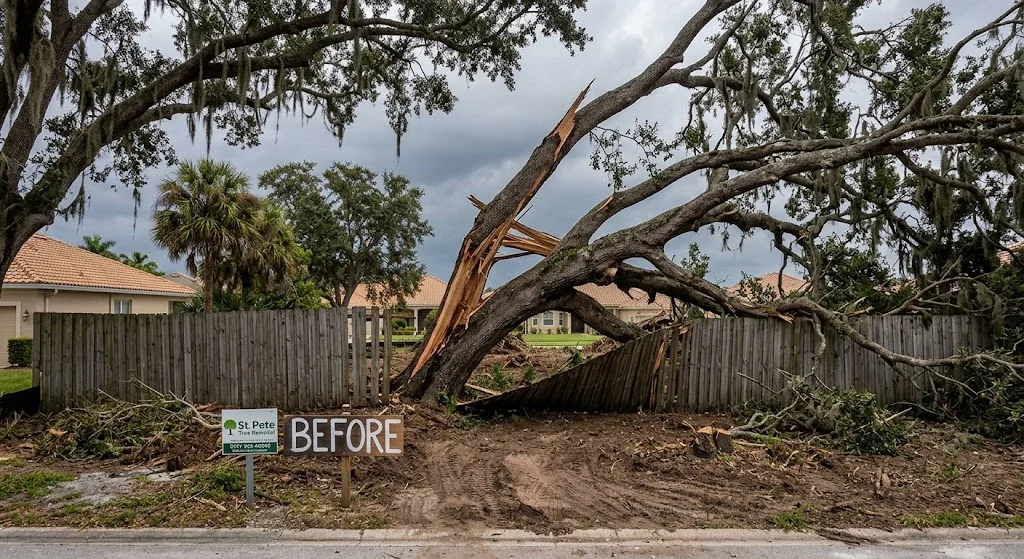
Permit questions come up constantly in Old Northeast, Snell Isle, Historic Kenwood and Crescent Lake, simply because those neighborhoods have the highest concentration of century-old live oaks anywhere in the city. In newer subdivisions further from the historic core, the tree stock is generally younger and permit questions come up far less often, though we check every meaningful tree individually rather than assuming based on neighborhood.
It is also important to know which municipality applies
St. Petersburg's specimen and grand tree rules apply within St. Petersburg city limits. Several communities in our service area — including Gulfport, St. Pete Beach, Treasure Island, South Pasadena, Pinellas Park, Seminole and Largo — are separately incorporated cities with their own local governments, and if any tree ordinance applies there, it is that city's own rule rather than St. Petersburg's. We check jurisdiction as part of confirming permit status on every estimate.
How the process generally works
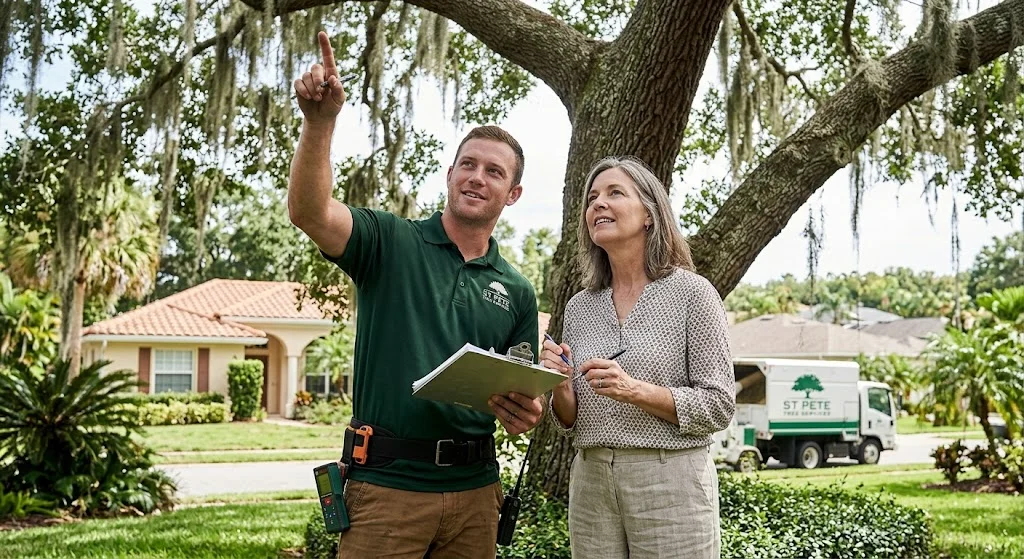
- Assessment — we measure trunk diameter, assess species and canopy spread, and document the tree's condition.
- Determination — based on that assessment, we tell you honestly whether the tree likely qualifies for protection and whether a permit is likely required.
- Application — where a permit is needed, we prepare and submit the application to the city's urban forestry office on your behalf, including our documentation of the tree's condition and the reason for removal.
- Review and approval — the city reviews the application, which can take anywhere from a short window to several weeks depending on current volume and the specifics of the request.
- Removal — once approved, we schedule and complete the removal as normal.
What happens if a protected tree is removed without a permit
Removing a protected specimen or grand tree without going through the required permit process can expose the property owner to city fines and potential requirements to mitigate the loss, such as replacement planting, regardless of who performed the actual cutting. This is exactly why we check status before quoting rather than after — it protects you, not just us.
Can a protected tree ever be saved instead of removed?
Often, yes, and it is usually our first recommendation on a structurally weak but otherwise healthy protected oak. Trimming and cabling can address many of the issues that make a homeowner consider removal in the first place — a heavy limb over a roof, a co-dominant trunk that looks unstable — without triggering the permit process at all, since routine maintenance pruning generally does not require one.
Our advice, in short
Do not assume either way. If your tree is large, appears old, and is a live oak or similar species, ask us to check before you plan around removing it. If it turns out to be protected, we will walk you through what that means and handle the paperwork. If it is not, you avoided an unnecessary delay. Either way, verifying with the city's urban forestry office directly is always a reasonable step alongside our assessment, especially for a borderline case.