
Licensed & insured Free on-site estimates Same-week scheduling Pinellas County & beaches
Call 727-624-0396

Palms

How Often Should Palm Trees Be Trimmed in Florida?

Once or twice a year for most sabal and queen palms, removing only dead fronds. More frequent than that, especially removing green fronds, does measurable harm rather than good.

Palm trimming frequency is one of the more persistently misunderstood parts of Florida landscape maintenance. The instinct many homeowners and landscapers share — trim it often, keep it tidy, do a full "hurricane cut" before storm season — is based on how you would treat a hedge, not how a palm actually grows and stores energy. Getting the frequency and technique right matters more for palm health than almost any other single maintenance decision.

How palms are different from other trees

A palm does not add new wood the way an oak does. Instead, all of its growth comes from a single growing point at the top of the trunk, and each frond it produces represents stored energy the palm draws on over that frond's lifetime. Removing a frond while it is still green — before the palm has finished drawing energy from it — is a genuine net loss to the tree, not a neutral cosmetic trim.

Trimming frequency by common local species

ItemDetail
Sabal palm (Florida's state tree)1–2x per year, dead fronds only
Queen palm1–2x per year, dead fronds only
Canary Island date palm1x per year, more conservative approach
Pygmy date palm1–2x per year, minimal trimming needed

Sabal and queen palms, the two most common species across St. Pete Beach, Treasure Island and the rest of our service area, need trimming once or twice a year at most, removing only fronds that have died or clearly begun declining. Canary Island date palms in particular respond poorly to aggressive trimming and warrant an even more conservative annual approach.
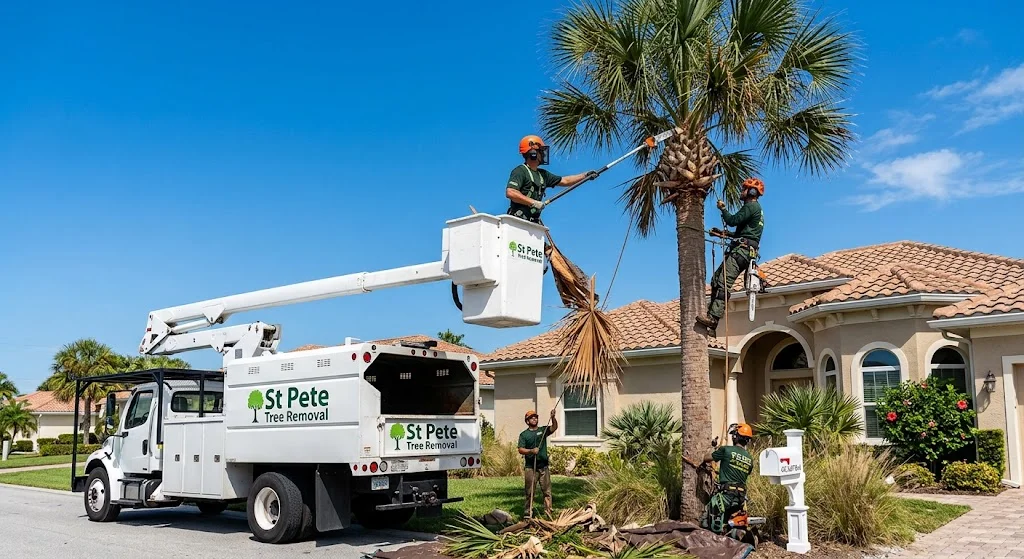
Properly trimmed sabal palm with only dead fronds removed in St. Pete Beach

How to tell a frond is actually ready to remove

The general guideline: a frond is safe to remove once it has browned and drooped below roughly the nine or three o'clock position relative to the trunk, indicating the palm has finished drawing usable energy from it. Removing green fronds still above that line, even ones that look a little tired, takes energy the palm has not yet finished using.

The "hurricane cut" problem

A true hurricane cut trims a palm down to a small tuft of remaining fronds, based on the idea that fewer fronds mean less wind resistance and less storm damage. This does not hold up well in practice — palm crowns are naturally wind-flexible by design, unlike the broad canopy of a hardwood, so aggressive pre-storm trimming does little to reduce actual wind damage risk.

What it reliably does is remove fronds the palm needs for ongoing energy production, leaving it visibly stressed and slower to recover its full crown afterward. We do not perform hurricane cuts for this reason, and we would rather explain why than take the job.
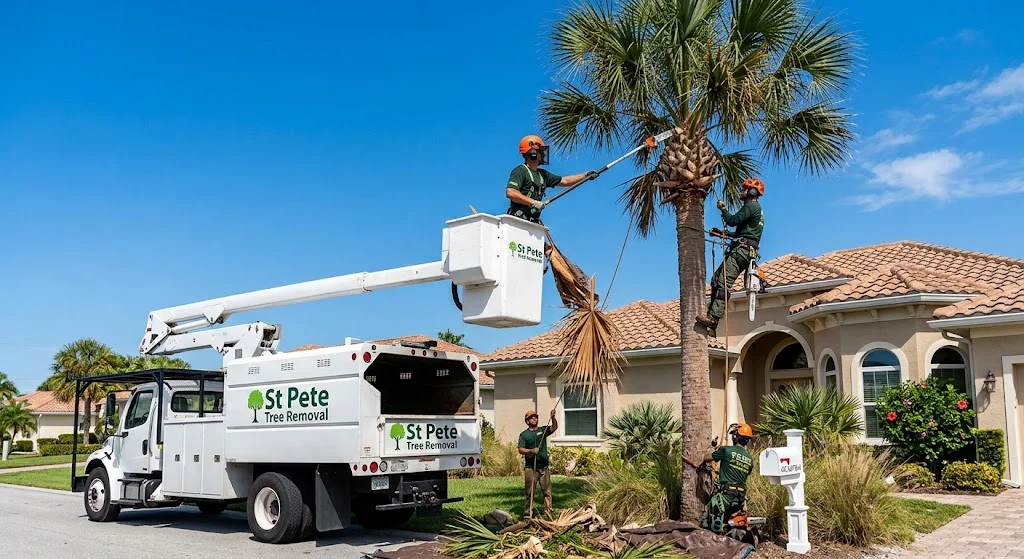
Storm prep without the hurricane cutA reasonable, non-aggressive trim ahead of hurricane season — removing genuinely dead and loose fronds only — reduces windborne debris without the drawbacks of a true hurricane cut. This is simply a normal trim done at a useful time of year, not a different technique.
Comparison of a properly trimmed palm crown versus an over-trimmed palm crown

Signs of over-trimming

  • A visibly thin, sparse crown compared to a similar palm that has been trimmed more conservatively.
  • Slowed new growth — a stressed palm often produces new fronds more slowly than a healthy one.
  • Increased vulnerability to pests — stressed palms are more attractive to certain palm weevils and borers.
  • Pencil-pointing of the trunk — in severe, chronic over-trimming cases, the trunk itself can narrow near the crown from prolonged stress.

Disease signs to watch for regardless of trimming schedule

Ganoderma butt rot and lethal bronzing are both present in the Tampa Bay area and are unrelated to trimming frequency, though a stressed, over-trimmed palm may be somewhat more vulnerable overall. A conk (shelf fungus) at the trunk base or unusual, uniform discoloration across the crown are signs worth a professional look regardless of your trimming schedule. See our tree removal page if a palm has progressed to the point where removal is the safer answer.

What we recommend

Once or twice a year, dead fronds only, for the sabal and queen palms that make up most of the palm canopy in our service area. Skip the hurricane cut. If you are unsure whether your palm has been over-trimmed in the past or needs a different approach for its specific species, our palm tree trimming page covers full pricing and we are happy to assess your specific palms on an estimate.

Need this looked at? Free on-site estimate anywhere in our service area, with a flat written price before we start. Call 727-624-0396 or request a quote.

Questions

Related questions

Once or twice a year, removing only dead or clearly declining fronds. Sabal palms — Florida's state tree and the most common palm in our service area — do not need more frequent trimming, and more frequent trims typically mean removing fronds that are not yet ready to come off.

No, this is a persistent myth. Palm crowns are naturally wind-flexible, so removing green fronds does little to reduce actual storm damage risk. What it reliably does is remove fronds the palm still needs for energy production, leaving it stressed rather than protected.

A hurricane cut trims a palm down to a small tuft of remaining fronds before a storm. It does not meaningfully reduce wind damage and does measurable harm by removing fronds the palm needs, leaving it visibly weaker and slower to recover. We explain this rather than perform them.

A general guideline is once it has browned and drooped below roughly the nine or three o'clock position relative to the trunk, indicating the palm has finished drawing usable energy from it. Green fronds still above that position are not yet ready to come off.

No. Sabal and queen palms do well with trimming once or twice a year. Canary Island date palms respond poorly to aggressive trimming and warrant an even more conservative, typically once-a-year approach given their different growth pattern.

A visibly thin or sparse crown compared to a conservatively trimmed palm nearby, slower new frond growth, and in severe chronic cases, a narrowing of the trunk near the crown known as pencil-pointing. Over-trimmed palms are also somewhat more vulnerable to certain pests.

It can contribute to overall stress, which may make a palm somewhat more attractive to certain pests like palm weevils. It is not a direct cause of specific diseases like Ganoderma butt rot, but a chronically stressed palm is generally less resilient overall.

Once or twice a year is still the right general guideline even for beachfront properties, though we assess each palm individually — coastal wind and salt exposure can occasionally lead to somewhat faster frond decline, which we would flag on a case-by-case basis rather than defaulting to a different universal schedule.

Have it assessed rather than assuming more trimming will help — a stressed appearance is often a sign the palm has already been over-trimmed in the past, and giving it a season or two without cutting green material is usually the better path to recovery.

Yes, removing heavy fruiting stalks is a normal and reasonable part of a standard trim, done mainly for cleanliness and to reduce a minor mess and impact hazard rather than because the palm needs it removed for health reasons.

It depends on the cause. If decline is due to past over-trimming, a conservative approach going forward can often support recovery over time. If the cause is a disease like Ganoderma butt rot, trimming will not help and removal is generally the safer answer once diagnosed.

Palm trimming is entirely standalone — you do not need any removal work to schedule a trim. See our palm tree trimming page for pricing, which runs $75 to $250 per palm depending on height and frond count.

Get your tree taken down right

Free on-site estimate, flat written price, and a crew that does nothing but trees. Tell us what needs to come down and we'll tell you what it costs.

Mon–Sat 7:00am–7:00pm (24/7 emergency line for storm work) · Licensed & insured · Serving St. Petersburg, Gulfport, Largo & the beaches

Tap to call Free quote